
 Contact us
 Refer us
 Work with us
 Customer portal
 Resource hub
 Blog
 Pay your invoice
 Feedback
Behind Closed Doors: Why Family and Domestic Violence Is Everyone’s Business
This week marks the beginning of the 16 Days in WA campaign, a statewide initiative that calls on all Western Australians to help prevent family and domestic violence and support those impacted by it.
At Avivo, safety is one of our highest priorities, not only for the people we support, but for our employees too. We believe everyone deserves to feel safe, respected and supported in the places they live, work and connect with others.
The reality in Western Australia
Family and domestic violence continues to affect thousands of people across Western Australia every year.
Previous WA Police statistics recorded more than 42,000 family and domestic violence offences during 2024-25. Experts and support services acknowledge that many incidents still go unreported, meaning the true impact is likely much greater.
Family and domestic violence can affect anyone regardless of age, gender, culture, ability, income or postcode. However, women remain disproportionately affected. Department of Communities information shows that one in four women and one in fourteen men have experienced violence by an intimate partner since the age of 15. Behind every statistic is a person, a family member, a friend, a colleague or a neighbour whose safety has been impacted.
Many people remain in unsafe situations because of fear, financial dependence, isolation, concern for children or uncertainty about where to find support.
Domestic violence isn’t always visible
When people think about domestic violence, they often think about physical injury. But family and domestic violence takes many forms.
It can involve emotional abuse, psychological abuse, coercive control, financial abuse, technology-facilitated abuse, sexual violence, stalking and social isolation. Often, these behaviours develop gradually and can become normalised over time. Coercive control is frequently at the centre of abusive relationships. It can involve monitoring someone’s phone, controlling access to money, limiting contact with family and friends, or creating an environment where a person feels fearful and unable to make their own decisions.
Many people experiencing abuse do not immediately identify their experiences as family and domestic violence. The impacts can continue long after a person has left a relationship and often affect every aspect of their life, including their health, employment and sense of safety.
Why this matters to us
In late 2022, Avivo tragically lost our colleague, Lynn Cannon, who was murdered by her ex-husband. Lynn’s death deeply affected our organisation and prompted us to reflect on how workplaces can better recognise, respond to and support employees experiencing family and domestic violence.
Her loss is not simply a reminder of what is at stake. It is a call to action. This work is dedicated to Lynn and to every person who has experienced, witnessed or been affected by family and domestic violence.
What we’re doing
Following Lynn’s death, Avivo committed to understanding how we could better support our employees and remove barriers that may prevent people from seeking help.
We’ve listened to people with lived experience to better understand the challenges employees face when navigating violence and abuse. We’ve reviewed our systems and practices to identify where unintentional obstacles may exist. We’ve strengthened our internal capability through training, clearer processes and trauma-informed approaches. And we’ve improved our crisis response so employees can access support safely, confidentially and without fear of judgement.
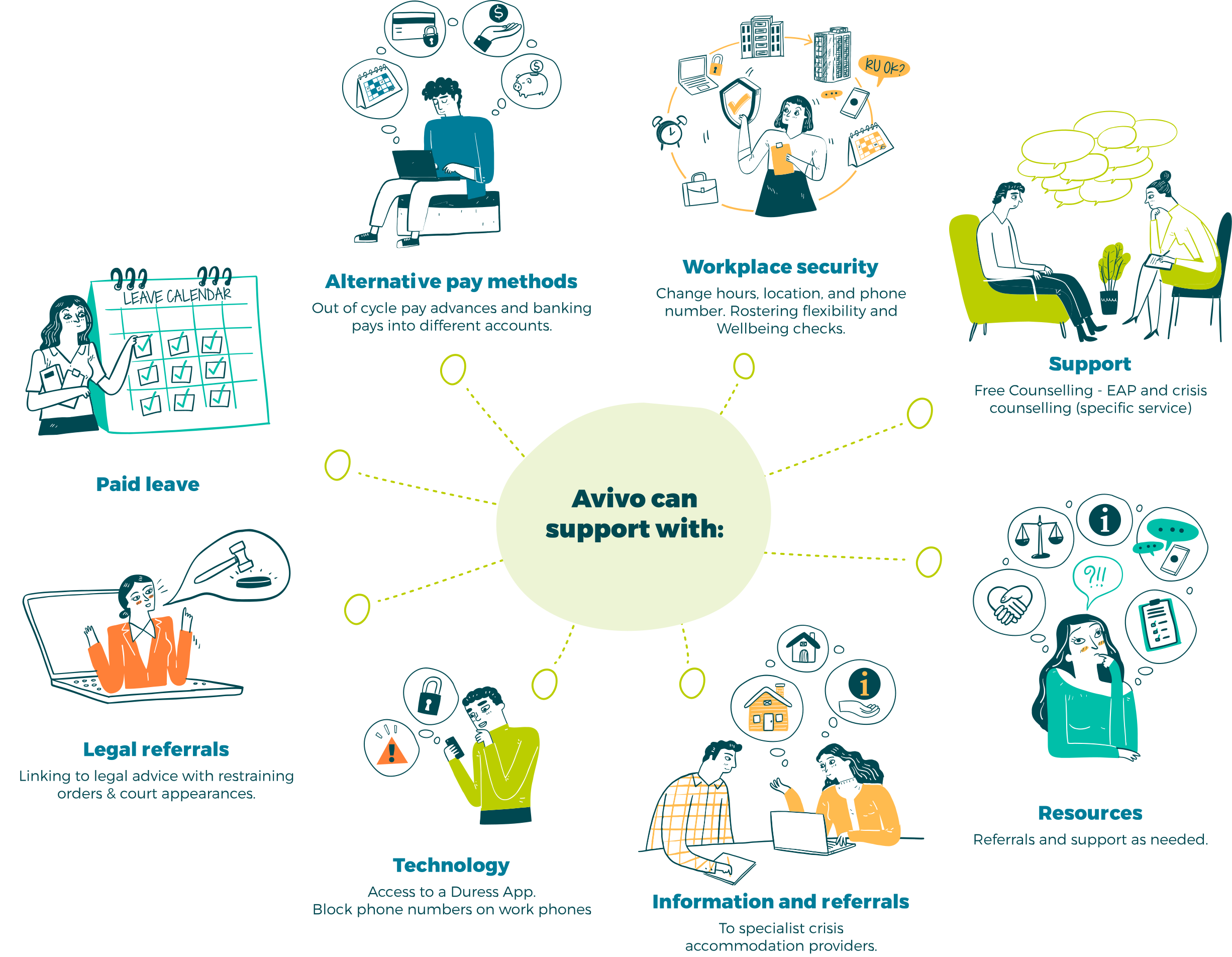
The image below highlights some of the practical ways Avivo now supports employees experiencing family and domestic violence. These measures are designed to increase safety, reduce barriers and ensure support is available when it is needed most.
Our work has also been informed by evidence and research that examines the role workplaces can play in supporting employees experiencing abuse.
Read the report:
https://www.avivo.org.au/wp-content/uploads/2025/11/Family-and-Domestic-Violence-Sector-Report.pdf
Creating safer communities together
Preventing family and domestic violence is everyone’s responsibility. Safe communities are built when people feel connected, respected and able to seek support without fear.
Sometimes making a difference starts with simple actions:
- Listening without judgement.
- Believing someone when they disclose abuse.
- Helping connect people with appropriate support services.
- Challenging attitudes that normalise control, abuse or violence.
- Creating environments where people feel safe to speak up.
These actions may seem small, but they can have a lasting impact. We believe stronger communities are built when people feel safe, included and connected.
Where to get help
If you, or someone you know needs support, help is available.
1800 RESPECT: 1800 737 732
Women’s Crisis Line: 1800 811 811
Men’s Referral Service: 1300 766 491
Lifeline (24 hour crisis line): 131 114
Avivo’s EAP: Please call Assure Wellbeing 1800 808 374.
In an emergency please call 000
 How it works
 Pricelist
 Funding options
 How to apply
 Age care FAQ

 How to apply
